
(In the Exact Order I Did Them)
There’s a version of this story that sounds simple.
Grow your salon. Hire a manager. Step away.
That’s not what happened.
The truth is, I spent years overworked, underpaid, and completely misaligned before I figured out how to build a salon that could actually function without me behind the chair.
If you’re trying to do the same, here’s exactly what I did, in order.
1. I Hit a Financial Breaking Point
Before anything changed, my salon was doing strong revenue.
And I was still broke.
I was working a full schedule behind the chair, double shifting with an assistant, running the brand, managing the team, and trying to hold everything together at once.
From the outside, it looked successful.
Behind the scenes, it was chaos.
There was a moment where my bank account was deeply negative and I was still showing up every day pretending everything was fine.
That’s when it clicked:
Revenue without profit is just noise.
If your business model doesn’t work, working harder won’t fix it.
2. I Fixed the Model (Not Just the Effort)
In 2014, I was introduced to Summit Salon Business Center.
I didn’t go in thinking I’d overhaul my business.
I went because I needed answers.
What changed everything wasn’t motivation. It was structure.
The two biggest shifts:
We moved to à la carte pricing
We stopped bundling services and started pricing based on time, effort, and value.
No more giving away parts of the service for free.
We implemented a level system
A clear growth path where stylists earn their way up based on performance.
Not tenure. Not opinions. Not favoritism.
Performance.
Stylists track key metrics like:
- Service performance
- Retail contribution
- Retention and pre-booking
- Overall consistency
When they hit those benchmarks consistently, they level up.
With that comes a price increase and a commission increase.
They are in control of their growth.
What this actually did:
- Created accountability
- Made pricing make sense
- Aligned pay with performance
- Turned the salon into a real business
Within months, the financial picture completely changed.
Not because we worked more.
Because the model finally worked.
3. I Slowly Removed Myself From the Chair
I didn’t walk away overnight.
That’s one of the biggest mistakes I see owners try to make.
We built Urban Betty on relationships and trust. I wasn’t going to disrupt that.
So I took a measured approach.
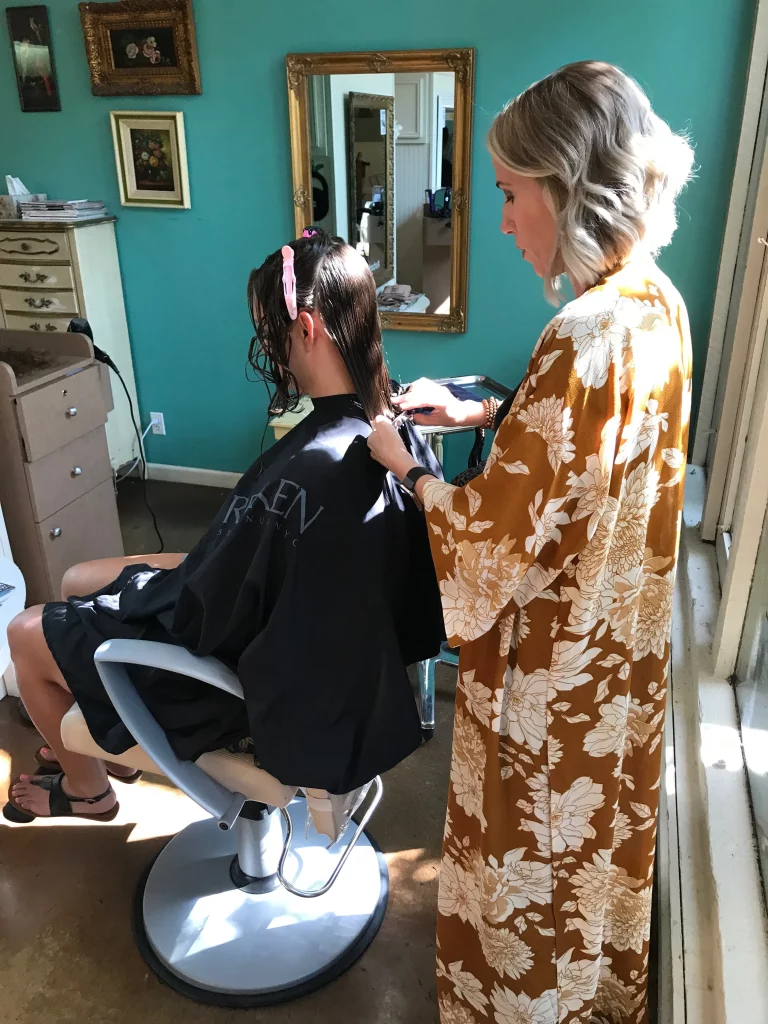
Every six months, I removed one working day from my schedule.
Not randomly. Intentionally.
This allowed:
- Guests to transition naturally
- Stylists to step up
- Systems to absorb the change
Most of my guests were transitioned to stylists who had assisted me.
They already knew them.
They already trusted them.
Yes, we lost a small percentage of guests.
That’s part of it.
But every new guest walking in only knew the new structure.
And that’s where the long-term growth lives.
4. I Built a Business That Could Pay Me Without Me
This is where most people get it wrong.
You cannot step away from the chair until your business can replace your income.
Not theoretically. Actually.
For me, that meant reaching a level of revenue and profit where:
- I could pay myself what I made behind the chair
- The business could sustain leadership roles
- Operations didn’t depend on me being present
The key levers that made this possible:
Pricing that reflects time and value
Every service stands on its own.
A commission structure that scales properly
Not everyone starts at the same rate.
Growth is earned and tied to performance and responsibility.
Higher-level stylists contribute more to the business, including training and supporting the next generation.
Clear metrics across the board
Everyone knows what success looks like.
And more importantly, how to get there.
5. I Rebuilt My Identity Outside of Doing Hair
This is the part no one prepares you for.
When you’re behind the chair, you are constantly validated.
You’re creating. You’re connecting. You’re being praised.
Then you step away…
And your role becomes problem-solving.
Feedback replaces compliments.
Responsibility replaces recognition.
If you’re not prepared for that shift, it can take you out.
For me, the only way through it was to find something I genuinely loved on the other side.
That became marketing, PR, and brand building.
I leaned all the way in.
- Social strategy
- Website experience
- Awards and visibility
- Brand positioning
- Internal communication and initiatives
That’s where I found my new identity as an owner.
Not by leaving something behind.
But by fully stepping into something else.
What My Role Looks Like Now
Stepping away from the chair didn’t mean stepping away from the business.
It meant focusing on the parts that actually grow it.
Today, my time is spent on:
- Marketing and brand strategy
- Financial oversight and planning
- Leadership development
- Manager alignment and support
- Company-wide initiatives and communication
This is where the real leverage is.
Who This Is Not For
This path isn’t for everyone. At least not yet.
You are not ready to step away from the chair if:
- Your income still depends on your personal clients
- Your salon is not consistently profitable
- You don’t have systems that can operate without you
- You don’t have a team capable of carrying the standard
Stepping away too early doesn’t create freedom.
It creates instability.
The Reality
Getting out from behind the chair isn’t about working less.
It’s about building something that works without you.
That requires:
- Fixing your business model
- Making decisions not everyone will like
- Letting go of your ego
- And stepping into a completely different role
That’s the order.
That’s what worked.